My family history is now in a museum!
|
By Miguel Pérez
The feeling is indescribable. Nothing prepares you for the pride that overwhelms you as you see your own family history showcased in a museum. You want to laugh and cry and the same time. You want everyone to see what you are seeing. Even in a quiet museum, you want to scream! There are truly no words to describe it, not enough to do it justice. But forgive me, I must try. Eleven years ago, in the summer of 2015, when I found that my father's image was part of a Cuban refugee exhibit in Miami's Freedom Tower museum, I wrote a column for the Creators Syndicate describing the shock and immense honor I felt. |

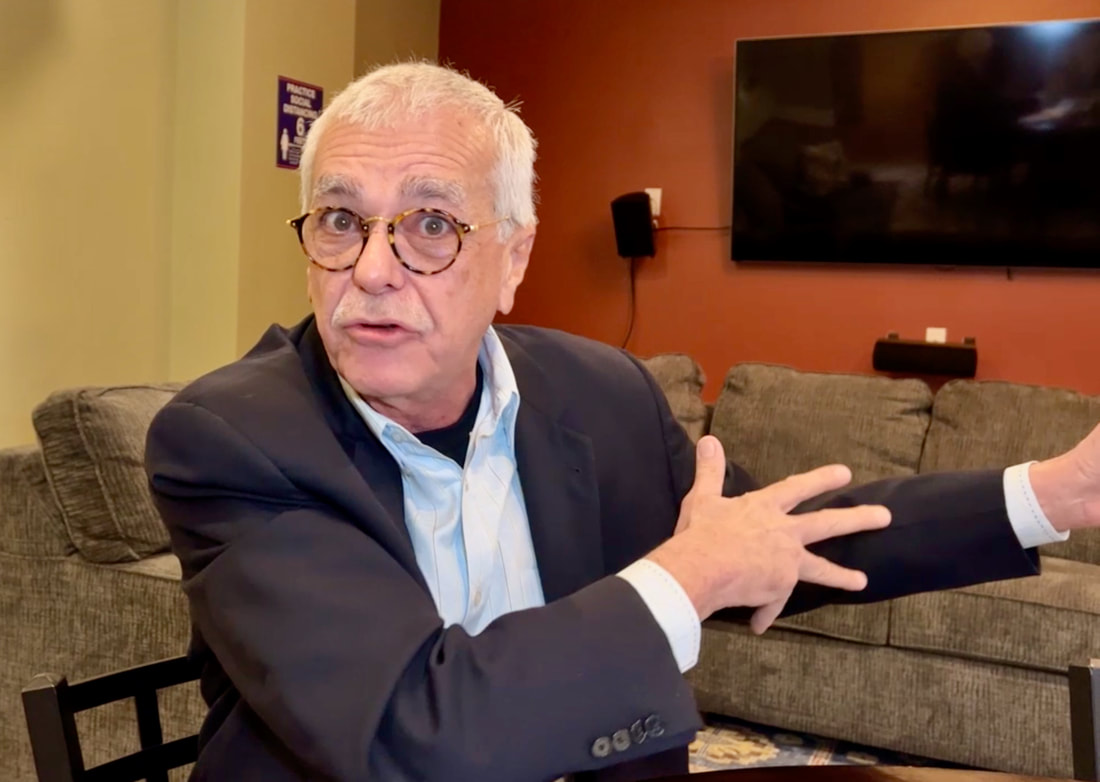
In 2026, Professor Miguel Pérez stands next to the image of his father in 1962.
|
|
You may have read that column, "Finding Dad in a Museum," on this website. It features a photo of me pointing to my dad, Benito Pérez, in a huge photo as he stood in line waiting for our family's food ration in the early 1960s.
However, lately, some friends from Miami have been telling me that I needed to return to see my father's exhibit again. While his photo was large before, they told me, now that the museum has been renovated, it takes up an entire room! Of course, I had to see this with my own eyes! So, on the eleventh anniversary of the day I found my father there, I went back to see what they had done with my old man. For emotional support, my dear friend, journalist Santiago Oms and his wife Ivonne came with me. And I cried and smiled again. |

In 2015, Prof. Pérez found his dad in a museum.
|
|
Now the image of my father is so large that I could stand next to him, shoulder to shoulder. (See photos). It was incredibly moving, even realizing that now I'm the old man! I'm 76. In that 1962 photo, my dad was 44 years old. He was 68 when he died in Miami in 1987.
And as if this wasn't enough to make me feel reflective, emotional and exhilarated, I was pleasantly surprised and humbled to find that my own oral history is now part of another exhibit in the museum. On another trip to Miami two years ago, the museum was closed for renovations and I couldn't get in to check up on my old man. But some folks at Miami-Dade College, which runs the museum, invited me for an interview about my own experience as a boy refugee in the Freedom Tower. |

In 2026, after the museum was renovated, they stand shoulder-to-shoulder!
|
|
I was told they were researching the tower's history during the years when it served as the Cuban Refugee Center — South Florida's Ellis Island! We spoke for a long time, but I had no idea of how my input would be used, if at all.
Yet, much to my surprise, I found that I'm quoted in different parts of the exhibit and my entire interview is one of many "Oral Histories" showcased in large high-tech monitors that are frankly impressive. You put on earphones and press a button, and you hear me talking for almost 45 minutes! The entire text of what I'm saying also scrolls on the screen. I expected them to perhaps use short clips of my long discussion with Rene Ramos, the college archivist at Miami-Dade. But they allowed me to narrate my family history much further than I had expected. It was awesome! As Ramos artfully extracted my oral history from me, we discussed my childhood in Cuba and my initial impression of Miami when I arrived there at the age of 11 in 1962, especially my recollection of my experiences in the Freedom Tower. We discussed my career as a journalist and college professor, my travels around this country in search of our Hispanic heritage, my website reporting on my research, my Hispanic American history course at Lehman College, and the history books I'm currently writing. |


|
|
Needless to say, I was delighted with the opportunity to boast, at least a little.
But Ramos also wanted to know how my life experiences have made me the person I am today. And so he asked for my definition of words like "immigrant," "refugee," and "home." And as I expressed my pride in being both an immigrant and a refugee in my American home, my responses made me see myself a little better. I had a chance to speak about some of my dearest relatives: My father, who created his own business by delivering produce to Cuban bodegas in Little Havana. My mother, a teacher in Cuba and housekeeper in Miami Beach hotels, who would take me to the Freedom Tower, "el refugio," to make sure I got proper medical care – from vaccinations to nerdy eyeglasses. My rich grandfather, an agriculture genius who lost a fortune to communism. My grandmother and her "paradise" of tropical fruits. My brother, who sacrificed his youth to get the family out of Cuba and to feed us all when we arrived. And my uncle, the journalist who was my role model. They are all buried in Miami. But making their stories a part of this exhibit makes me feel extremely fortunate. I did right by them! |

Prof. Pérez takes photos of his own oral history exhibit.
|
|
I had a chance to discuss my early teenage years growing up in Little Havana, when my family was very poor and where I delivered The Miami News on a bicycle in the afternoons, and I spent my Saturdays helping my father deliver produce to Cuban bodegas.
And we also spoke about how much Miami has changed since I moved to New York to attend the Columbia University Graduate School of Journalism in 1977, and how I no longer think I belong there. My newspaper route was in "the Brickell area," and my clients lived in houses that been replaced by huge high-rises. The Miami I knew is no longer there. Some of my fellow Cubans have changed too. Their support for the current president has made them forget that we came here for freedom and democracy, and that right-wing lawless authoritarians are just as bad as those on the left who forced us to flee from our homeland. |

|
|
Yup! The interview became a little political, but how do Cuban-Americans tell their family history without getting political? ´Es imposible!
Yet here I am, extremely grateful to the Freedom Tower, for giving my family refuge in 1962 and for giving me the opportunity to share my family history 64 years later. It's a huge, humbling honor! |
|